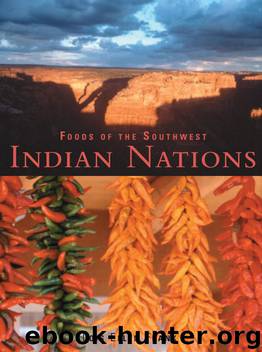
Foods of the Southwest Indian Nations by Lois Ellen Frank
Author:Lois Ellen Frank [Frank, Lois Ellen]
Language: eng
Format: epub
ISBN: 978-0-307-81469-2
Publisher: Ten Speed Press
Published: 2013-01-29T16:00:00+00:00
Debi Breen harvesting ripened prickly pear fruit.
The aridity of the desert can cause a scarcity of many foods, but the wild plants that nature has given to this region are hardy enough to survive the long droughts and cold winters. Each spring, the cacti bud, the fruits ripen, and the herbs and greens sprout anew. These signs of spring coincide with warmer days, increased sunshine, and a new beginning to the harvesting year.
Many greens grow wild in all parts of the Southwest, along highways and in pastures, amid desert rocks, and beside planted gardens. Wild greens, such as lamb’s-quarter (Chenopodium album), also called wild spinach; dandelion greens (Taraxacum officinale); mustard (Descurainia pinnata); wild mint (Mentha arvensis); purslane (Portulaca oleracea), called verdolagas throughout New Mexico and peehala by the Hopi; and pigweed (Amaranthus palmerii), or quelites as it is called in Spanish, can all be harvested in the springtime. Most of these greens are harvested young, in early spring before the plant has flowered or the characteristic bitter taste becomes too strong. Tumbleweed grows all over the Southwest. Tender young shoots from the tumbleweed plant (Salsola iberica/Salsola kali) are harvested in the spring, when the plant is still young and green. It is a vegetable that is delicious in soups, stews, and salads. The small shoots are harvested when they are 2 to 3 inches tall, before they develop thorns.
Wild onion (Allium cernuum) and wild celery (Cymopterus fendleri) are harvested during the spring and summer. Indian tea (Thelesperma megapotamicum), also called cota or hohoise by the Hopi, is harvested in the late spring and summer months. Virtually all of the Pueblo tribes, as well as the Hopi, Diné, and Apache, know this plant and consider it the best of several wild plant species for making tea. The flowers and stems of this plant are harvested, then tied into small bundles and dried for use throughout the year.
Many fruits exist in the wild. Cultivated fruits such as peaches, apricots, plums, cherries, and apples are harvested annually. These cultivated fruits that are grown in the desert without irrigation by a dry-farming method tend to be smaller than commercially grown fruits but are very sweet and tasty. The fruits grown with irrigation in parts of northern New Mexico along the Rio Grande are larger. During July, August, and September, the fruits ripen and are enjoyed fresh or dried, or are made into jellies and syrups.
Squawberry (Rhus trilobata), a wild berry also called lemonade berry, is harvested in the summer months and is made into a refreshing beverage; it is also ground and used to flavor sauces. Wild currants (Ribes inebrians), wild gooseberry (Ribes inerme), and chokecherry (Prunus virginiana) are usually found at higher elevations. They are harvested in late summer when the berries are bright to deep red, in some cases almost black, and very smooth. Few are eaten fresh when they are in season; the majority are dried for winter use. These berries are quite common, and remains of pits have been found at several Anasazi sites in northwestern New Mexico.
Download
This site does not store any files on its server. We only index and link to content provided by other sites. Please contact the content providers to delete copyright contents if any and email us, we'll remove relevant links or contents immediately.
Biscuits: A Savor the South Cookbook by Belinda Ellis(4371)
The French Women Don't Get Fat Cookbook by Mireille Guiliano(3705)
A Jewish Baker's Pastry Secrets: Recipes from a New York Baking Legend for Strudel, Stollen, Danishes, Puff Pastry, and More by George Greenstein(3646)
Better Homes and Gardens New Cookbook by Better Homes & Gardens(3633)
Ottolenghi Simple by Yotam Ottolenghi(3630)
Al Roker's Hassle-Free Holiday Cookbook by Al Roker(3554)
Trullo by Tim Siadatan(3469)
Hot Thai Kitchen by Pailin Chongchitnant(3431)
Bake with Anna Olson by Anna Olson(3425)
Panini by Carlo Middione(3372)
Nigella Bites (Nigella Collection) by Nigella Lawson(3264)
Momofuku by David Chang(3214)
Salt, Fat, Acid, Heat: Mastering the Elements of Good Cooking by Nosrat Samin(3177)
Modern French Pastry: Innovative Techniques, Tools and Design by Cheryl Wakerhauser(3167)
Classic by Mary Berry(3054)
Best of Jane Grigson by Jane Grigson(3032)
Tapas Revolution by Omar Allibhoy(3022)
Solo Food by Janneke Vreugdenhil(3004)
Ottolenghi - The Cookbook by Yotam Ottolenghi(2982)
